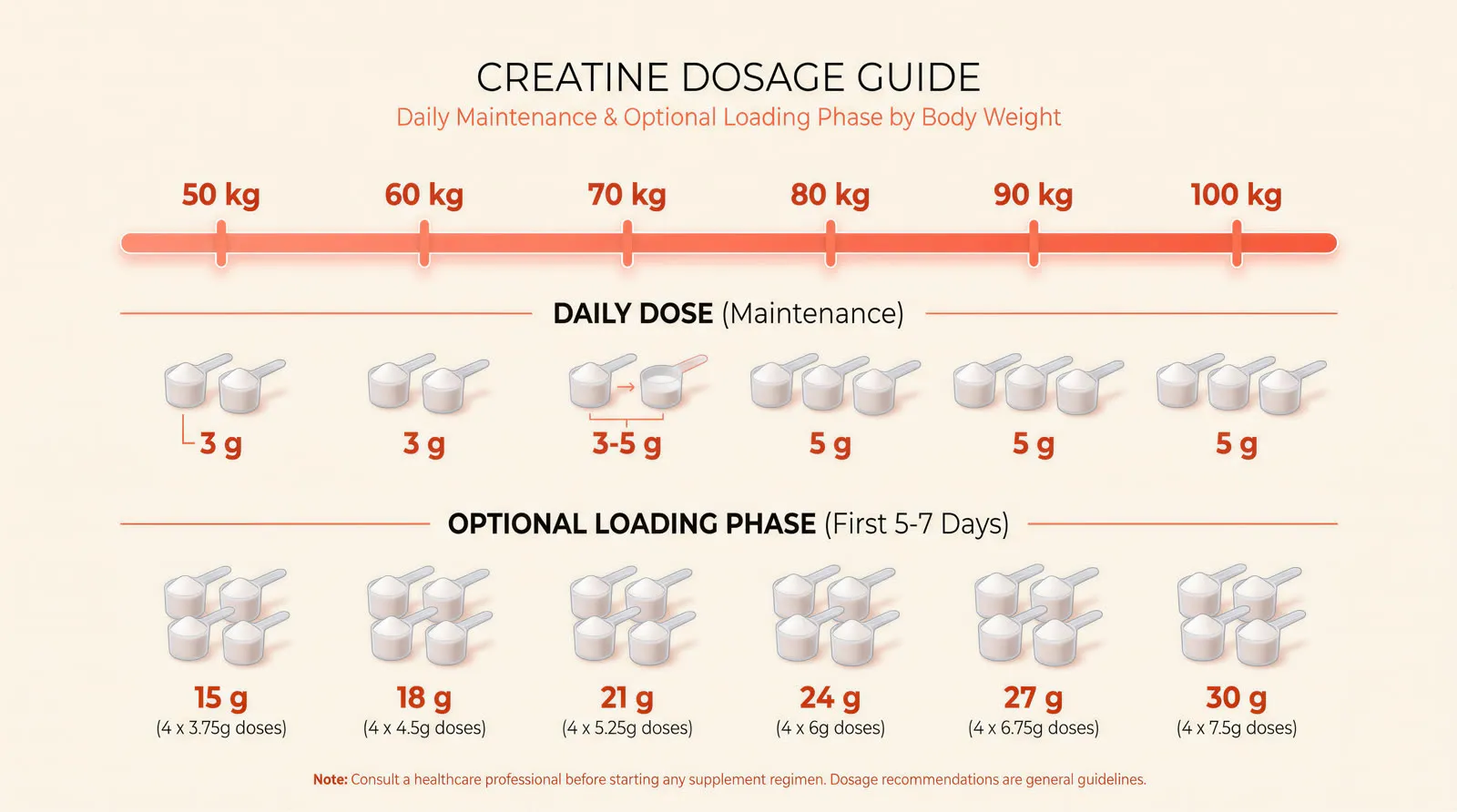
Most adults need 3–5 g of creatine monohydrate a day. Loading is optional. Enter your weight and get your daily grams, a loading schedule if you want one, and the date you'll be saturated.

Creatine works by filling your muscle stores. Once they are full, more does nothing except cost money and water.
3–5 g a day (about 0.03 g per kg). Every day, training or not.
0.3 g per kg split into 4 doses for 5–7 days. Saturates in a week instead of a month.
Any time of day. With a meal or carbs if your stomach is sensitive.
Monohydrate powder is the tested one. Gummies work if they actually contain creatine.
Each guide gives the number first, then the evidence and the mistakes to avoid.
The scale moves before the mirror does. That is water inside the muscle, not fat, and it is the sign it's working.
+1–2 kg of water in the muscle, fuller look, sometimes mild bloating if you load.
An extra rep or two on your heavy sets; faster recovery between sets.
Visible muscle with training. Without training, creatine does very little.
For a 65 kg person. Your calculator result adjusts every number to your weight.
| Day 1–5 | 4 × 5 g with meals (20 g total) |
| Day 6–7 | 3 × 5 g, or switch to maintenance |
| Week 2+ | 5 g once a day, any time |
| Skip loading? | 5 g a day saturates in about 4 weeks |
| Water | +0.5 L a day during loading |
| Sensitive stomach | Split doses, take with food, or skip loading |
| Missed a day | Just continue; stores drop slowly over weeks |
| Same protocol for women; smaller loading doses by body weight. | |
Women typically store less creatine in muscle and respond at least as well to supplementation. The dose is the same range, usually at the lower end by body weight: 3 g for most women under ~65 kg, 5 g above that. Loading is optional and can be scaled to 15–18 g a day rather than a flat 20 g. Everything women ask about (water weight, bloating, hair, cycle, menopause) is answered in Creatine for women and How much creatine should a woman take.
There's no toxicity at sensible doses, but there's a point of no return on benefit: after saturation, anything over ~5 g a day (or ~0.1 g/kg for very large people) is excreted. During loading, 25–30 g a day is the practical ceiling; above that you're buying stomach upset, not results. "Too much" shows up as bloating, cramps and loose stools, always from the size of a single dose, not the daily total. Split doses fix it. See Loading phase side effects.
Less than the internet says. Creatine pulls water into muscle, so add roughly one or two extra glasses a day, spread out. You don't need to double your intake, and peeing every half hour means too much water, not too much creatine.
Week one: possibly 1–2 lb of water inside muscle and slightly fuller muscles (faster if you loaded). Weeks 2–4: hard sets feel a rep easier. Month 2 and on: strength and lean gains that outpace training alone. Photos and timelines: Creatine before and after.
Creatine monohydrate at 3–5 g/day is one of the most studied supplements and is considered safe for healthy adults. It raises blood creatinine, a kidney marker, so tell your clinician you supplement before lab tests. If you have kidney disease, take medications that affect the kidneys (some blood pressure drugs, NSAIDs, diuretics), are pregnant or breastfeeding, or are under 18, talk to a clinician first. Thyroid medication (levothyroxine) has no known interaction with creatine, but the same rule applies: ask.
Not harmful for healthy adults, but unnecessary after saturation; 3–5 g does the job. 10 g/day is a reasonable "gentle loading" option for the first two weeks.
About 90 kg: 5 g a day maintenance. Optional loading around 27 g/day (5 × 5 g) for 5–7 days.
Nothing common is dangerous. Old worries about caffeine or acidic juice degrading creatine haven't held up in practice. Alcohol doesn't interact chemically but works against your training. Don't rely on creatine dissolved and left in liquid for days.
Creatine accounts for about 2–4 lb of water in muscle. Anything beyond that is food, salt, water balance or training changes.
Ask your prescribing clinician. Some blood pressure drugs affect the kidneys, and creatine changes creatinine readings; your doctor should know before you start.
Usually one level scoop of plain monohydrate, but scoops vary from 3 to 5 g. Check the label, or weigh once: 5 g is about one level teaspoon; the full method is on how to take creatine.
Yes, if you train. It helps keep strength and muscle in a deficit. Expect a small water gain that isn't fat.
Dose by your weight, loading yes or no, training days — day by day, with reminders.
Build my planCreatine Dosage team. Educational content, not medical advice.
 Creatine Dosage