 Creatine Dosage
Quick answer: The natural sources of creatine are meat and fish, and almost nothing else. Herring is the richest food at roughly 6–10 g per kilogram raw; pork and beef carry about 4.5–5 g/kg; salmon and tuna 4–4.5 g/kg; chicken 3–4 g/kg; cod about 3 g/kg (1, 2). Eggs contain only a trace, milk about 0.1 g per litre, and plants essentially none. A typical omnivore eats 1–2 g of creatine a day, and the body makes about another gram; reaching the 3–5 g a day used in studies from food alone means roughly a kilogram of raw beef or a pound of herring every day, which is why the supplement exists. The calculator gives your daily number; this page tells you how much of it dinner already covers.
your weight and goal → grams per day, and how much of it your diet already covers
Where creatine in food comes from
Creatine is stored in muscle, so the foods that contain it are muscle: red meat, poultry and fish. Organ meats like liver and kidney contain little, because they are not skeletal muscle. Milk carries a small amount that leaks from the cow's tissue, and eggs almost none, because an egg is not muscle either. Plants do not make creatine at all; the "creatine" in a cranberry or a walnut is a rounding error. This is also why vegetarians and vegans measure lower muscle creatine stores in study after study and respond more to supplementing: they start further from the ceiling (3). Vegan creatine covers that side in detail.
Your body makes creatine too, about 1 g a day, in the liver and kidneys from three amino acids (arginine, glycine and methionine). That home-made gram plus whatever meat and fish you eat keeps muscle stores at roughly 60–80% of what they can hold. A supplement fills the last 20–40%, which is where the extra reps and the faster recovery come from (4). Food matters for your baseline; it is not a practical way to saturate.
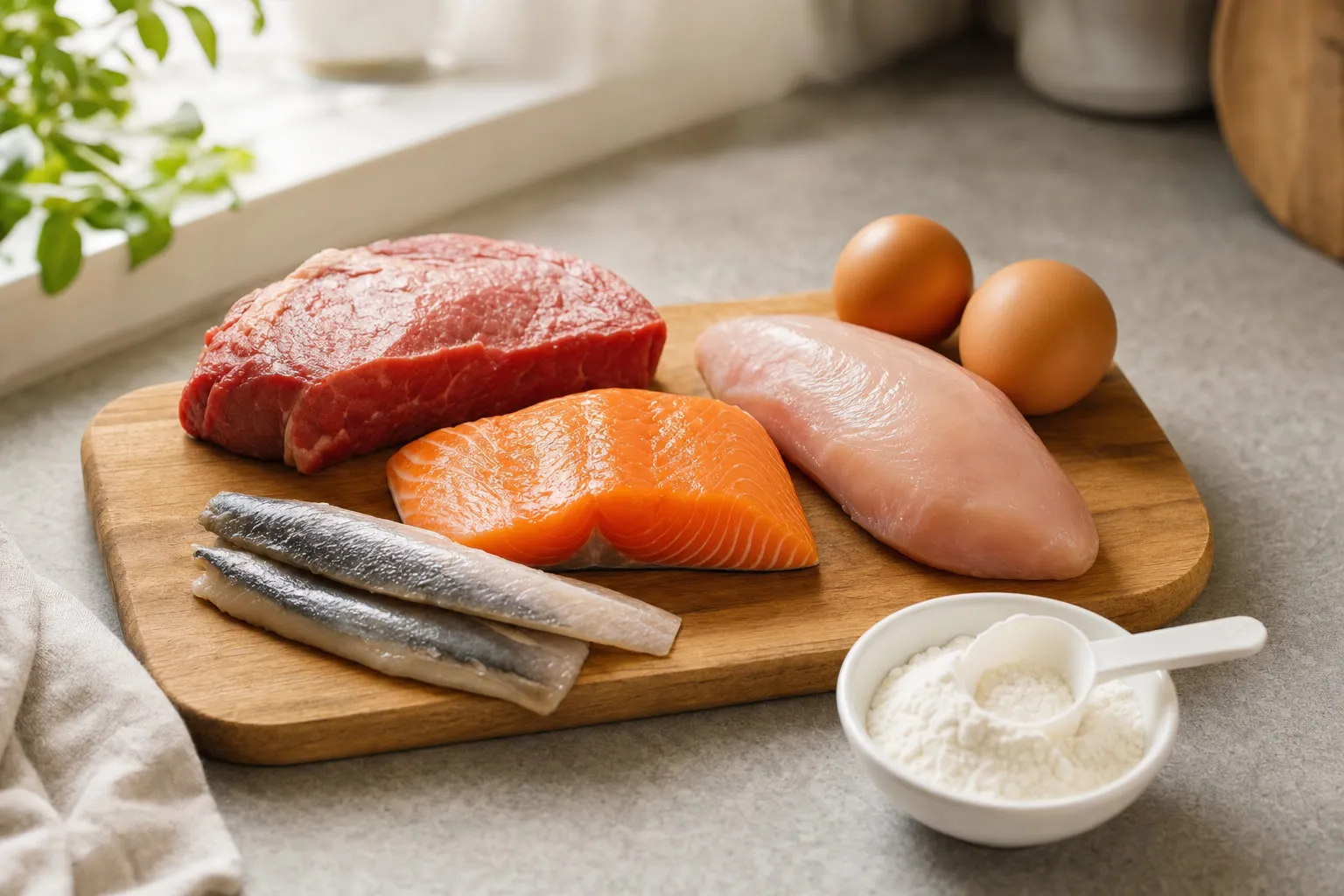
Foods high in creatine: the table
Values are for raw food; cooking losses are covered below. Per-serving figures use a standard 4 oz (113 g) portion for meat and fish.
| Food (raw) | Creatine per kg | Per 4 oz / 113 g serving | To get 5 g you would need |
|---|---|---|---|
| Herring | 6.5–10 g | 0.7–1.1 g | about 500–750 g (1.1–1.6 lb) |
| Pork | ~5 g | ~0.6 g | about 1 kg (2.2 lb) |
| Beef | ~4.5 g | ~0.5 g | about 1.1 kg (2.4 lb) |
| Salmon | ~4.5 g | ~0.5 g | about 1.1 kg (2.4 lb) |
| Tuna | ~4 g | ~0.45 g | about 1.25 kg (2.8 lb) |
| Chicken | 3–4 g | ~0.4 g | about 1.3–1.7 kg (3–3.7 lb) |
| Cod | ~3 g | ~0.35 g | about 1.7 kg (3.7 lb) |
| Lamb, turkey, venison | 3–4.5 g (estimates) | ~0.4–0.5 g | 1.1–1.7 kg |
| Eggs | trace (well under 0.1 g) | ~0.01 g in two eggs | not realistic |
| Milk | ~0.1 g per litre | ~0.02 g per glass | not realistic |
| Cheese, yogurt | trace | trace | not realistic |
| Plants, grains, nuts, legumes | essentially 0 | 0 | not possible |
| Creatine monohydrate powder | 880 g (88% creatine) | 5 g scoop = 4.4 g creatine | one scoop |
The numbers come from the classic analyses of creatine content in foods (1, 2, 5) and are ranges because muscle creatine varies with the animal, the cut and how fresh the fish is. The order is what matters: fish and red meat at the top, poultry and white fish in the middle, everything else near zero.
How cooking changes creatine in food
Heat converts some creatine into creatinine, which the body does not use. The loss depends on temperature and time more than the method: a quickly seared steak or pan-fried fillet keeps most of its creatine, while long stewing, boiling or pressure cooking can lose a third or more, and some creatine leaves into the cooking liquid (1, 5). Practical rules:
- Grilling, searing and roasting to medium: roughly 10–20% loss.
- Stewing, braising, slow-cooking, boiling: 20–40% loss, partly into the liquid; soups and stews return some of it if you eat the broth.
- Canned tuna and cured or smoked fish: lower than fresh because of processing heat.
- Raw preparations (sashimi, tartare, pickled herring): closest to the table values.
So a cooked 8 oz (225 g) steak, the kind of portion people call "a lot of meat", delivers about 0.8–1 g of creatine. Two such meals a day gets an omnivore to the 1.5–2 g range that studies of typical diets report (2, 5).
How much creatine do you get from a normal diet?
- Omnivore who eats meat or fish at most meals: about 1–2 g a day from food, plus ~1 g made by the body. Muscle stores around 70–80% full.
- "Chicken and eggs" eater, little red meat or fish: roughly 0.5–1 g a day from food. Stores in the 60–70% range.
- Pescatarian: depends entirely on how often fish appears; a salmon dinner most days is close to the omnivore number.
- Vegetarian or vegan: near zero from food; muscle creatine relies on the ~1 g the body makes. Stores at the lower end, which is why the response to supplementing is larger (3).
- Women in general: tend to eat less red meat and carry lower stores to begin with; the dose is the same 3–5 g, and the change is often more noticeable. How much creatine should a woman take does the math by body weight.
None of these groups reaches the 3–5 g a day of the research dose from food, and none can get to full muscle saturation by eating more. That is the honest framing: food sets your starting point; a supplement changes it.
Can you get 5 g of creatine naturally?
Technically yes, practically no. Five grams a day from food means about a kilogram of raw beef, 1.1 kg of salmon, or roughly a pound and a half of herring, every day, before cooking losses. That is 2,000–2,500 calories of meat, a lot of saturated fat and a food bill that dwarfs a $0.15–0.40 scoop of creatine monohydrate. Even hardcore meat-eaters in dietary surveys land around 2 g a day, not 5.
What is realistic is raising your baseline: a serving of fish or red meat most days keeps stores at the top of the "normal diet" range, which has its own value for strength, recovery and the brain (4). If you want the full effect measured in trials, the extra reps, the faster recovery between hard sets, the lean-mass change over months, that comes from supplementing 3–5 g daily on top of whatever you eat; creatine benefits lists what the evidence supports and how long creatine takes to work gives the timeline.
Food vs supplement: the same molecule, different amounts
The creatine in a herring fillet and the creatine in a scoop of monohydrate are the same molecule, absorbed the same way. A study that fed creatine as a food ingredient (in meat) and as a supplement found comparable uptake into the blood, with the food version slightly slower because it comes packaged in protein (5). There is no "natural" advantage to food creatine and no "synthetic" drawback to powder: monohydrate is made from sarcosine and cyanamide, is vegan by default, and is the form used in nearly every trial (types of creatine compared).
The difference is dose and cost. Food gives 0.5–1 g per generous serving; a scoop gives 4–5 g for a few cents. Loading (20 g a day for 5–7 days) is impossible with food and optional anyway; do you need to load creatine explains why 3–5 g daily reaches the same place in about four weeks, and maintenance dose covers what to take afterward.
How to increase creatine naturally, if you would rather not supplement
- Put fish or red meat on the plate most days; herring, salmon, pork and beef are the top of the table.
- Cook hot and fast rather than long and wet, or eat the broth from stews.
- Keep protein adequate: the body makes creatine from amino acids, and very low protein diets lower the home-made gram.
- Do not chase "creatine-rich" plant foods; there are none. Plant eaters who want the effect need the supplement, and it is vegan.
- Train. Creatine stores are used and refilled by hard, short efforts; muscle you use holds more.
That is the whole natural toolkit. It moves your baseline a little; it cannot move it to where 3–5 g of powder does.
Creatine, creatinine and creatine kinase: three things that get mixed up
Searches for creatine sources often come from a blood test, so a quick untangle:
- Creatine is the fuel molecule in muscle, from food, synthesis or a supplement.
- Creatinine is the breakdown product of creatine, measured in blood as a kidney marker. Eating a lot of meat or supplementing raises it slightly, which reflects more creatine, not kidney damage; tell the lab you supplement. Is creatine bad for your kidneys covers the test in detail.
- Creatine kinase (CK) is an enzyme that leaks from muscle after hard training or injury; a "high creatine kinase" result is about muscle stress and has nothing to do with how much creatine you ate.
Who should ask first
Creatine from food is just food. Supplementing 3–5 g a day has one of the longest safety records of any supplement in healthy adults (4), but ask a doctor or pharmacist first if you have kidney disease or take medication that affects the kidneys or potassium, if you are pregnant or breastfeeding, or under 18. The common side effects, water weight in the first two weeks and stomach upset from large single doses, are on creatine side effects.
FAQ
What foods are highest in creatine?
Herring, at roughly 6.5–10 g per kg raw, then pork and beef (about 4.5–5 g/kg), salmon and tuna (4–4.5 g/kg), chicken (3–4 g/kg) and cod (about 3 g/kg). A 4 oz serving of any of them gives about 0.4–1 g. Eggs, dairy and plants contain a trace or none.
How much creatine is in 2 eggs?
Almost none, in the region of 0.01 g. Eggs are not muscle tissue, so they carry only a trace. Two eggs give you excellent protein and the amino acids your body uses to make its own creatine, but not meaningful creatine itself.
How do I get 5 g of creatine naturally?
You would need about a kilogram of raw beef or salmon, or a pound and a half of herring, every day, before cooking losses. Nobody eats that way; typical omnivores get 1–2 g a day. A 5 g scoop of creatine monohydrate is the practical route and is the same molecule.
How do I increase my creatine naturally?
Eat fish or red meat most days, cook hot and fast rather than boiling for hours, keep protein adequate so your body can make its own gram, and train. That raises your baseline stores a little. Full saturation, the level in studies, only comes from a supplement.
Is creatine from food better than a supplement?
No, it is the same molecule. Food delivers it in smaller amounts, packaged with protein and calories; the supplement delivers 3–5 g for a few cents with nothing else attached. Studies that compared creatine from meat and from powder found similar absorption.
Why do doctors say no to creatine?
Usually caution left over from older assumptions about the kidneys, or because the patient has kidney disease, where caution is appropriate. For healthy adults the long-term safety data are strong. Mention that you supplement before a blood test, because creatine raises creatinine.
Do vegetarians need creatine?
They do not need it to be healthy; the body makes about 1 g a day. But their muscle stores are measurably lower than meat-eaters', and trials show vegetarians gain more from supplementing. Plain creatine monohydrate is vegan.
Does cooking destroy creatine in meat?
Some of it. Searing or grilling loses roughly 10–20%, long stewing or boiling 20–40%, with part of it going into the liquid. The rest converts to creatinine, which the body does not use. Eating the broth from a stew returns some of the loss.
Sources
- Balsom PD, Söderlund K, Ekblom B. Creatine in humans with special reference to creatine supplementation. Sports Med. 1994;18(4):268–280.
- Brosnan JT, Brosnan ME. Creatine: endogenous metabolite, dietary, and therapeutic supplement. Annu Rev Nutr. 2007;27:241–261.
- Burke DG, Chilibeck PD, Parise G, Candow DG, Mahoney D, Tarnopolsky M. Effect of creatine and weight training on muscle creatine and performance in vegetarians. Med Sci Sports Exerc. 2003;35(11):1946–1955.
- Kreider RB, Kalman DS, Antonio J, et al. International Society of Sports Nutrition position stand: safety and efficacy of creatine supplementation in exercise, sport, and medicine. J Int Soc Sports Nutr. 2017;14:18. https://pmc.ncbi.nlm.nih.gov/articles/PMC5469049/
- Deldicque L, Décombaz J, Zbinden Foncea H, Vuichoud J, Poortmans JR, Francaux M. Kinetics of creatine ingested as a food ingredient. Eur J Appl Physiol. 2008;102(2):133–143.
- Ostojic SM. The evolving role of creatine in public health: from food-based nutrient to supplement and beyond. Public Health Nutr. 2025. https://pmc.ncbi.nlm.nih.gov/articles/PMC12722096/
Creatine Dosage team. Educational content, not medical advice.