 Creatine Dosage
Quick answer: There are about eight types of creatine sold, and one of them has the evidence. Creatine monohydrate is the form used in nearly every study: 3–5 g a day, about $0.15–0.40 per dose. Micronized creatine is the same monohydrate ground finer so it mixes better. Creatine HCL, buffered creatine (Kre-Alkalyn), creatine ethyl ester, creatine nitrate, liquid creatine, magnesium chelate and creatine phosphate are variations that cost two to six times more and have not been shown to raise muscle creatine or strength any better in head-to-head trials (1, 2). The dose that matters is grams of creatine reaching your muscle, and the calculator gives you that number; it does not change with the form.
your weight and goal → grams per day, any form
Why there are so many types of creatine
Creatine monohydrate has been sold since the early 1990s and its patent-free status makes it cheap. A brand cannot charge much for a commodity, so the industry has spent thirty years attaching something to the creatine molecule (an acid, a buffer, an ester, a nitrate group, a magnesium atom) and claiming the new form absorbs better, needs a smaller dose, does not bloat, or skips loading. Most of those claims come from the manufacturer's own lab work on solubility in a glass, not from trials measuring what ends up in muscle. Monohydrate is already absorbed almost completely from the gut, close to 99 percent, so there is very little room to improve on it (1, 3). That single fact explains most of the table below.
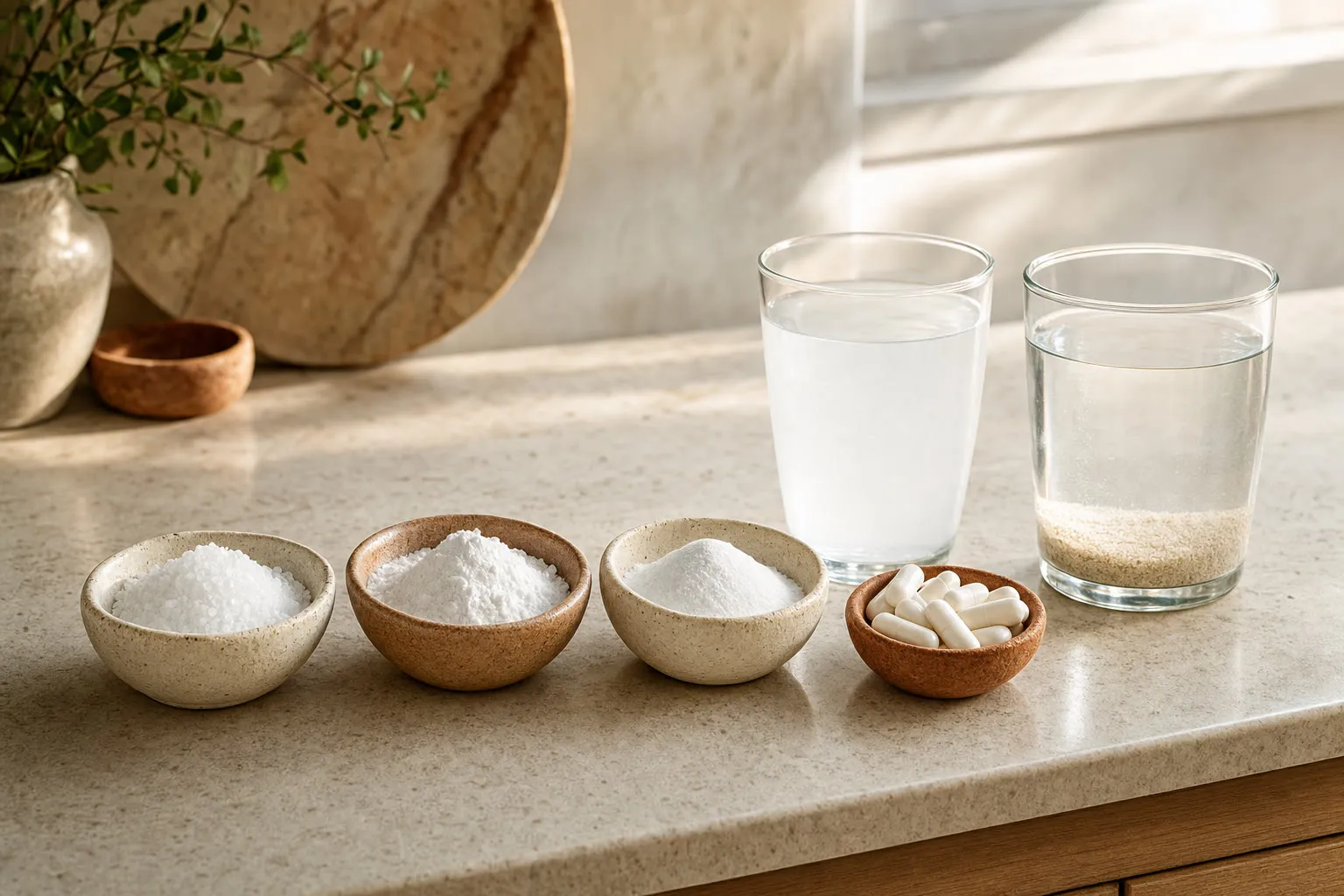
All types of creatine compared
| Type | What it is | Evidence it works | Typical dose | Price per dose | Stomach and mixing |
|---|---|---|---|---|---|
| Creatine monohydrate | Creatine + one water molecule; 88% creatine by weight | Hundreds of trials; the reference standard (1) | 3–5 g/day; optional 20 g/day loading for 5–7 days | $0.15–0.40 | Gritty in cold water; mild upset only with big single doses |
| Micronized monohydrate | Same molecule, milled ~20× finer | Same as monohydrate (it is monohydrate) | 3–5 g/day | $0.20–0.45 | Mixes and sits better; the fix for grit and a sensitive stomach |
| Creatine HCL | Creatine bound to hydrochloric acid; ~78% creatine | A handful of small trials: about equal to monohydrate, not better (4, 5) | Labels say 1.5–3 g; no evidence a smaller dose saturates muscle | $0.60–1.50 | Dissolves instantly; fine for people who dislike grit |
| Buffered creatine (Kre-Alkalyn) | Monohydrate with an alkaline buffer, pH ~12 | One independent trial: no advantage over monohydrate, no less creatinine (6) | 1.5–3 g claimed; effectively needs the same 3–5 g | $0.50–1.20 | Fine; the "no bloating" claim is marketing |
| Creatine ethyl ester (CEE) | Creatine with an ester group attached | Worse: breaks down to creatinine before reaching muscle; lower muscle creatine than monohydrate (7) | 2–3 g claimed | $0.50–1.00 | Bitter; the one form to actively avoid |
| Creatine nitrate | Creatine bound to a nitrate group | Small safety and performance studies; no evidence it beats monohydrate; the nitrate is the pre-workout "pump" ingredient | 1–3 g, usually inside pre-workouts | Bundled | Very soluble; check total creatine, it is often under 3 g |
| Liquid creatine | Creatine dissolved in water or glycerol | Creatine degrades to creatinine in solution; tests find much less creatine than labelled (8) | Whatever survives on the shelf | $1–2 | Convenient, unreliable dose |
| Creatine magnesium chelate | Creatine bound to magnesium | One or two small trials, about equal to monohydrate; no advantage shown | 3–5 g | $0.50–1.00 | Fine; you also get some magnesium |
| Creatine phosphate, citrate, malate, pyruvate | Creatine bound to other acids; lower creatine percentage | Sparse; citrate and pyruvate about equal to monohydrate at matched creatine; phosphate has no supplement evidence | 3–5 g of creatine content | Varies | Citrate dissolves well; more grams of powder for the same creatine |
| Gummies and capsules | Monohydrate in a different delivery | Same as monohydrate, if the label dose is real | 3–5 g (often 3–6 gummies or 6–10 capsules) | $0.50–2.50 | Convenient; gummies often under-dosed in lab tests |
The column that matters is the third one. Every form has to prove one thing: that it raises muscle creatine stores at least as well as monohydrate does. Only micronized monohydrate does that by definition, because it is monohydrate. The rest either match it at a higher price or, in the case of ethyl ester and liquid creatine, fall short (7, 8). A 2011 review of the "novel" forms and the International Society of Sports Nutrition's position stand both reach the same conclusion: no other form has been shown to be more effective than monohydrate (1, 2).
The three main types of creatine, in more detail
People also ask for "the three main types". In practice the shelf comes down to three families: monohydrate (including micronized), HCL, and buffered. The rest are niche.
Creatine monohydrate and micronized monohydrate
Monohydrate is the reference: the loading protocol (20 g a day for 5–7 days, then 3–5 g), the no-loading protocol (3–5 g every day, saturation in three to four weeks), the safety data over decades, and the strength and lean-mass results all come from monohydrate trials (1). Micronized is the same powder milled finer: it stays suspended in water longer, feels smoother and is gentler on some stomachs, for a few cents more per dose. If your only complaint about monohydrate is grit at the bottom of the glass, micronized solves it. The monohydrate buying guide has the five label checks; the loading phase guide explains how to start.
Creatine HCL
Creatine hydrochloride is about 40 times more soluble than monohydrate in water, which is real and is the whole basis of the "you need less" claim. But solubility in a glass is not absorption in the body, and the small trials that compared HCL and monohydrate head-to-head found both worked about the same; none found HCL doing more at a lower dose (4, 5). HCL makes sense for people who cannot stand grit and have already tried micronized, or whose stomach reacts to any monohydrate dose. It does not make sense as a way to take 1.5 g and expect 5 g results. The full comparison, dose for dose, is on creatine HCL vs monohydrate.
Buffered creatine (Kre-Alkalyn)
Buffered creatine is monohydrate with the pH raised, sold on the idea that stomach acid destroys ordinary creatine and the buffer protects it. The premise is wrong: creatine survives the stomach well enough that monohydrate is absorbed almost completely. The one independent trial that tested Kre-Alkalyn against monohydrate at the label doses found no advantage in muscle creatine, strength or body composition, and no reduction in creatinine (6). It is safe; it is just monohydrate at three times the price.
The types to avoid
Creatine ethyl ester is the only common form with evidence of being worse. The ester group was supposed to help creatine cross cell membranes; instead it makes the molecule unstable, so much of it converts to creatinine (the inert breakdown product) in the gut and blood. A 7-week trial found ethyl ester raised muscle creatine less than monohydrate and raised blood creatinine more (7).
Liquid creatine has the same problem for a different reason: creatine in water slowly turns into creatinine, so a bottle that has sat in a warehouse for months contains less creatine than the label says, sometimes almost none (8). Pre-mixed creatine drinks meant to be consumed the same day are fine; ready-to-drink bottles with a long shelf life are not.
Gummies are not a form so much as a delivery, and they can be excellent or nearly empty. Creatine in a warm, moist, acidic gummy base degrades unless the formulation is done carefully, and independent tests in 2025–2026 found roughly half of popular brands under-dosed. Gummies vs powder and how many gummies make 5 g cover how to check.
Creatine + HMB blends are not a new form of creatine; they are monohydrate with a second supplement added (3 g a day of HMB is the studied dose, and many scoops give half that). The stack evidence is mixed, positive in beginners and flat in trained lifters, and is reviewed in creatine and HMB.
Which type of creatine is best for you
- You want results and do not care about the glass: plain creatine monohydrate. Cheapest, most studied, and the dose the calculator gives you.
- Grit or a slightly sensitive stomach: micronized monohydrate in warm water with a meal.
- You have tried micronized and still get gut upset, or you refuse a gritty drink: creatine HCL, taking the label dose but understanding it has not been shown to saturate muscle faster.
- You want convenience over price: capsules (count them; 5 g is usually 6–10) or third-party-tested gummies.
- You are vegan or vegetarian: any of the above; all supplemental creatine is synthetic, not animal-derived. Vegan creatine explains why plant-based eaters respond best.
- Women, over 40, on a cut, on GLP-1 medication: the form does not change; the dose and the reasons for taking it do. Start with creatine for women.
Whatever the form, look for a stated creatine content per serving (not "creatine blend"), a third-party test mark (Informed Sport, NSF, USP), and a price per 5 g of creatine that you have actually calculated from the label.
Does the type change the dose, the loading or the side effects?
Dose: no. Muscle saturation needs about 3–5 g of creatine a day for most adults, or roughly 0.03 g per kilogram; the calculator gives your number and it applies to every form. What changes is how much powder delivers that creatine: monohydrate is 88 percent creatine by weight, HCL about 78 percent, citrate about 40 percent. The maintenance dose page has the by-weight numbers.
Loading: optional for every form, not "unnecessary" for the new ones. Any form can be loaded at 20 g a day or simply taken at 3–5 g from day one and saturate in three to four weeks. The claim that HCL or buffered creatine "needs no loading phase" is true only in the sense that monohydrate does not need one either. See do you need to load creatine.
Side effects: the real ones are a 1–2 kg rise on the scale from water inside muscle, and stomach upset from a large dose taken dry or all at once. The water is caused by creatine itself, so it is identical for every form at the same creatine intake; switching from monohydrate to HCL to avoid it does not work. The stomach upset is about dose size and dissolving, which is why micronized and HCL help some people. Creatine side effects has the full real-vs-myth list, and weight gain and bloating explains the scale.
Safety note
Creatine monohydrate is one of the most studied supplements in sports nutrition and is considered safe for healthy adults at 3–5 g a day over years of use; the other forms are assumed to share that profile at matched doses but have far less long-term data. Creatine raises blood creatinine on lab tests, which can look like a kidney problem to a clinician who does not know you supplement; tell them before bloodwork (creatine and kidneys). Ask a clinician first if you have kidney disease, are pregnant or breastfeeding, are under 18, or take medication that affects the kidneys. Ethyl ester and long-shelf-life liquid creatine are not recommended on evidence grounds. This page is educational and not medical advice.
FAQ
What are the three main types of creatine?
Creatine monohydrate (including micronized monohydrate), creatine HCL, and buffered creatine (Kre-Alkalyn). Monohydrate has the research; HCL and buffered are variations that match it at best. Ethyl ester, nitrate, liquid, magnesium chelate and the citrate/malate/pyruvate salts are niche.
What is the best type of creatine?
Creatine monohydrate, micronized if you drink it in cold water. It is the form used in nearly every trial, costs the least, and no other form has been shown to raise muscle creatine or strength better. Everything else is paying more for the same result, or in the case of ethyl ester, a worse one.
What is better, creatine HCL or monohydrate?
For results, they are about equal in head-to-head trials at matched creatine intake. HCL dissolves far better and can be easier on a sensitive stomach; monohydrate is a third of the price and has decades of data. Take HCL for the glass, not for the muscle.
Who should not take creatine HCL?
The same people who should ask before any creatine: those with kidney disease, pregnant or breastfeeding, under 18, or on kidney-affecting medication. HCL has less long-term safety data than monohydrate, so if you are in a cautious group, monohydrate is the more studied choice.
Is it okay to switch from creatine HCL to monohydrate?
Yes, any time, with no washout. Both deliver the same molecule to muscle. Switch to 3–5 g of monohydrate a day and your stores stay saturated; you may notice slightly more grit in the glass and slightly more money in your account.
Which creatine does not cause bloating?
None avoids the 1–2 kg of water inside muscle, because creatine itself causes it. What people call bloating is usually gut upset from a big undissolved dose. Fix that with 3–5 g of micronized monohydrate in warm water with food, split any loading into 5 g doses, and only then consider HCL.
Is micronized creatine better than regular monohydrate?
Better in the glass, identical in the muscle. Micronized is regular monohydrate milled finer: it mixes better, settles slower and bothers fewer stomachs. Absorption is the same. Buy micronized if you drink creatine in water; buy regular if it goes in a shake. Full comparison: micronized creatine.
Why do doctors say no to creatine?
Usually caution from older assumptions about the kidneys, or because the patient has kidney disease, where caution is warranted. For healthy adults the long-term safety data on monohydrate is strong. The thing to tell your doctor is that creatine raises blood creatinine, so a routine kidney panel can look off while you supplement.
Sources
- Kreider RB, Kalman DS, Antonio J, et al. International Society of Sports Nutrition position stand: safety and efficacy of creatine supplementation in exercise, sport, and medicine. J Int Soc Sports Nutr. 2017;14:18. https://pmc.ncbi.nlm.nih.gov/articles/PMC5469049/
- Jäger R, Purpura M, Shao A, Inoue T, Kreider RB. Analysis of the efficacy, safety, and regulatory status of novel forms of creatine. Amino Acids. 2011;40(5):1369–1383. https://pmc.ncbi.nlm.nih.gov/articles/PMC3080578/
- Deldicque L, Décombaz J, Zbinden Foncea H, et al. Kinetics of creatine ingested as a food ingredient. Eur J Appl Physiol. 2008;102(2):133–143.
- França E, Avelar B, Yoshioka C, et al. Creatine HCl and creatine monohydrate improve strength but only creatine HCl induced changes on body composition in recreational weightlifters. Food Nutr Sci. 2015;6:1624–1630.
- Eghbali E, Arazi H, Suzuki K. Supplementation with creatine hydrochloride versus creatine monohydrate: effects on strength, body composition and hormonal responses in resistance-trained men. Phys Act Nutr. 2024;28(2):7–16.
- Jagim AR, Oliver JM, Sanchez A, et al. A buffered form of creatine does not promote greater changes in muscle creatine content, body composition, or training adaptations than creatine monohydrate. J Int Soc Sports Nutr. 2012;9:43. https://pmc.ncbi.nlm.nih.gov/articles/PMC3479057/
- Spillane M, Schoch R, Cooke M, et al. The effects of creatine ethyl ester supplementation combined with heavy resistance training on body composition, muscle performance, and serum and muscle creatine levels. J Int Soc Sports Nutr. 2009;6:6. https://pmc.ncbi.nlm.nih.gov/articles/PMC2649889/
- Antonio J, Candow DG, Forbes SC, et al. Common questions and misconceptions about creatine supplementation: what does the scientific evidence really show? J Int Soc Sports Nutr. 2021;18:13. https://pmc.ncbi.nlm.nih.gov/articles/PMC7871530/
Creatine Dosage team. Educational content, not medical advice.