 Creatine Dosage
Quick answer: Micronized creatine is plain creatine monohydrate milled into much smaller particles, typically around 200 mesh (under about 75 microns), roughly 20 times finer than standard powder. Nothing changes chemically: it is the same molecule, the same 3–5 g a day, and it raises muscle creatine exactly as well as regular monohydrate (1, 2). What changes is the glass: micronized powder disperses more evenly, settles slower and leaves less grit, and some people find it easier on the stomach. It costs about $0.02–0.10 more per dose. Buy it if grit or a gritty stomach has ever made you skip a day; otherwise regular monohydrate does the same job for less. Your dose is the same either way; the calculator gives it in grams.
your weight and goal → grams per day of micronized or regular monohydrate
What "micronized" actually means
Creatine monohydrate comes out of production as a crystalline powder with particles in the range of a few hundred microns, which is why a scoop of regular monohydrate feels sandy and sinks to the bottom of a glass. Micronizing is a mechanical step: the powder is milled or air-jet ground until the particles are much smaller, and manufacturers usually describe the result as "200 mesh" (particles that pass a 200-wire-per-inch sieve, so under roughly 75 microns) or say "20× finer". No chemical reaction happens and nothing is added. A micronized creatine monohydrate powder with one ingredient on the label is 100% creatine monohydrate, exactly like the regular version (creatine monohydrate explained).
Smaller particles have more surface area for the same weight, so they wet and disperse faster when stirred, stay suspended longer, and do not form the gritty layer at the bottom that people spoon out and swallow dry. That is the entire difference. Solubility itself, the amount that can dissolve in a given volume of water, is a property of the molecule and does not change: at room temperature roughly 14 g of creatine monohydrate dissolves in a litre of water whether or not it was micronized (3). Micronized powder looks more dissolved because the undissolved portion is spread through the liquid as a fine cloud rather than sitting on the bottom.
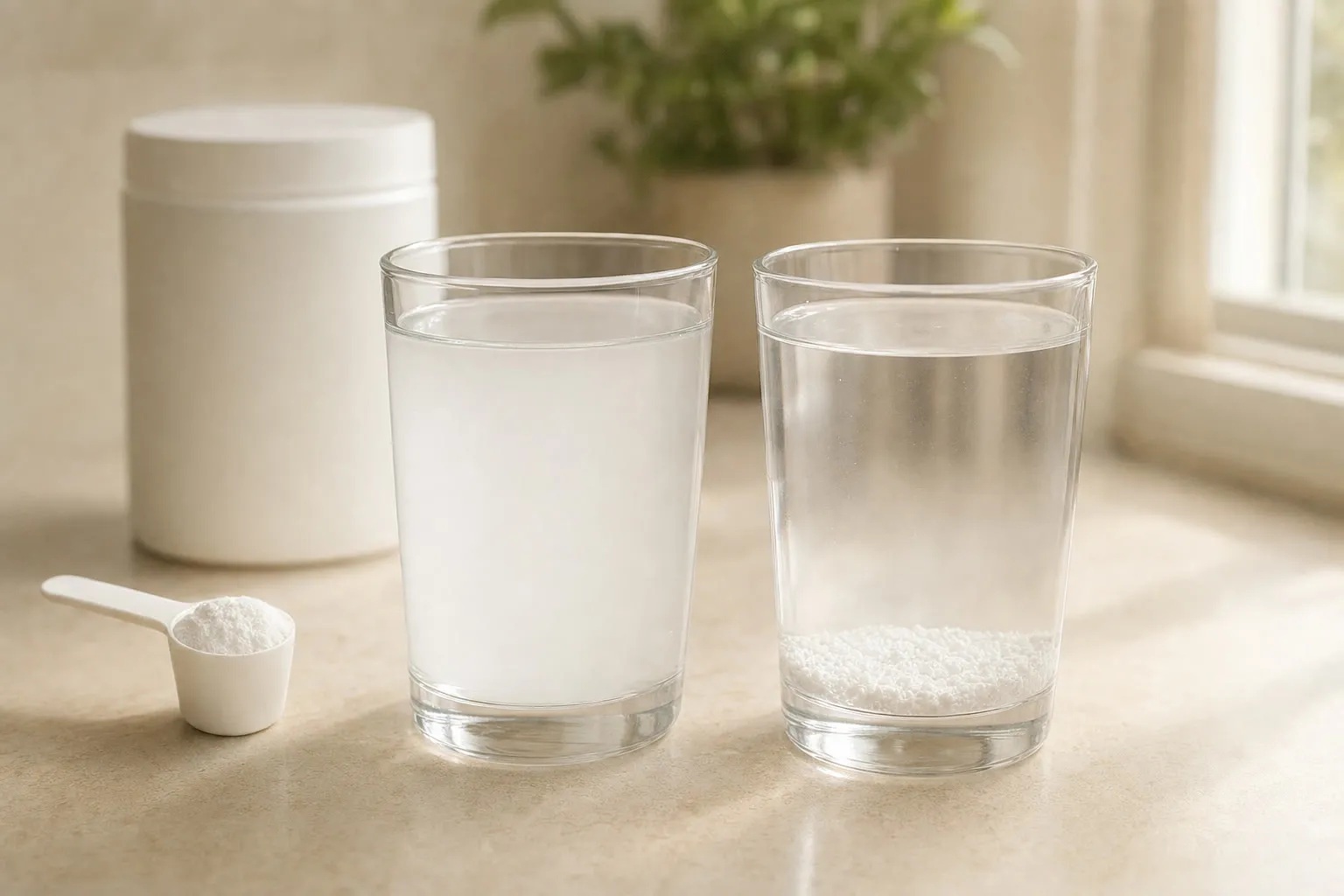
Micronized creatine vs regular creatine monohydrate
| Regular creatine monohydrate | Micronized creatine monohydrate | |
|---|---|---|
| Molecule | Creatine monohydrate (88% creatine by weight) | Identical |
| Particle size | Roughly 100–300 microns, sandy | Under about 75 microns (200 mesh), silky |
| Solubility limit | About 14 g per litre at room temperature | Same |
| In a glass of water | Sinks fast; gritty layer at the bottom | Disperses evenly; settles slowly; slight cloudiness |
| Mixing | Needs stirring; leftover grit | Stirs in with a spoon; almost no residue |
| Absorption | Near-complete (about 99% of an oral dose reaches the blood) | Same; no trial shows a difference |
| Muscle creatine after 4 weeks | +20–40% | Same |
| Strength and lean-mass effect | The reference for every trial | Same, because it is the same compound |
| Stomach comfort | Fine for most; grit and big doses upset some | Slightly gentler for sensitive stomachs; less undissolved powder in the gut |
| Dose | 3–5 g a day (20 g a day for 5–7 days if loading) | Same |
| Typical price per 5 g dose | $0.15–0.35 | $0.20–0.45 |
| Who it is for | Anyone who does not mind grit, mixes in a shake, or takes capsules | Plain-water drinkers, sensitive stomachs, people who quit because of texture |
Every row that matters for results is identical, which is the honest headline: micronized creatine is not "better creatine", it is the same creatine that is nicer to drink. The trials behind the strength, recovery and lean-mass findings used monohydrate, and a large share of the recent ones used micronized product because that is what the big brands sell; the outcomes are the same either way (1). The comparison with forms that actually differ chemically, HCL, buffered, ethyl ester, is on types of creatine and creatine HCL vs monohydrate.
Is micronized creatine better absorbed?
No, and this is the claim to be wary of. Marketing copy often says micronized creatine is "more bioavailable" or "absorbed faster". Creatine monohydrate is already absorbed almost completely: pharmacokinetic work shows around 99% of an oral dose is taken up, with the rest lost as creatinine, and there is no room for a finer powder to improve on that (2). Faster wetting in the glass does not translate into faster or greater uptake into muscle, because absorption in the gut is limited by transport, not by how quickly the powder dispersed in your cup. No study has shown micronized monohydrate raising muscle creatine higher, or sooner, than regular monohydrate.
Where particle size can matter is comfort. The most common creatine complaint, a heavy or upset stomach, usually comes from a large dose of undissolved powder sitting in the gut, typically during a loading phase or when a whole day's dose goes down at once. A finer powder is less likely to be swallowed as a clump, which is why people with sensitive stomachs often report that micronized "agrees" with them. That is real, small, and about the gut, not about results. The rest of the stomach fixes are on creatine side effects and does creatine make you bloated.
When paying extra for micronized is worth it
- You mix creatine in plain water or juice and drink it from a glass. Regular monohydrate leaves a sandy layer you either stir constantly or swallow at the end. Micronized fixes that for a few cents.
- You have skipped doses because of texture. The benefit of creatine depends entirely on taking it every day for weeks (how long creatine takes to work). Anything that makes daily use easier is worth more than the premium.
- A loading phase upset your stomach. Split micronized doses of 5 g four times a day with meals is the gentlest way to load; or skip loading, which do you need to load creatine explains gets you to the same place in about four weeks.
- You take it in a shaker with protein or in a smoothie. Regular monohydrate is fine; the shake hides the grit, and you will not notice a difference.
- You take capsules or gummies. Particle size is irrelevant; you are swallowing the powder either way. The real question there is the dose per piece (creatine capsules, how many creatine gummies equal 5 g).
Rule of thumb: if the tub you already have goes down fine, there is no reason to switch. If you are buying your first tub and drink creatine in water, buy micronized; the price gap is usually $2–8 per tub.
How to read a micronized creatine label
Because "micronized" has no legal definition, the label is where the difference lives. Five checks:
- One ingredient. "Creatine monohydrate (micronized)" and nothing else. Flavoured or "creatine complex" products add sugars, dextrose or other ingredients that dilute the dose.
- A stated dose per serving. 5 g of creatine monohydrate per scoop gives about 4.4 g of creatine (monohydrate is 88% creatine by weight). Labels that say "5 g creatine" for a 5 g scoop are rounding; it is fine, just know the number.
- Particle-size wording. "200 mesh", "20× finer", "micronized" or "ultra-fine" all describe the same thing. No brand publishes a micron distribution, so the wording is a promise, not a spec; the glass test below tells you whether it is true.
- Third-party testing. An Informed Sport, NSF or USP mark means the tub was tested for what it says and for contaminants. Creatine is cheap enough that a tested tub costs little more.
- Origin. "Creapure" is a German-made monohydrate with a long testing record, sold both regular and micronized. Chinese-made monohydrate is where most of the market comes from and is fine from a tested brand; the test mark matters more than the flag.
The glass test: stir 5 g into 250 ml of room-temperature water for ten seconds and leave it for a minute. Regular monohydrate forms a distinct sandy layer; genuinely micronized powder leaves a faint cloud with only a little fine residue. If your "micronized" tub sinks like sand, you paid for a word.
How to take micronized creatine
The dose does not change because the powder is finer. 3–5 g a day, every day, is the maintenance dose for most adults; the calculator on the home page gives your number by body weight (a common rule is 0.03 g per kg, so about 2 g for a 60 kg woman and 3 g for a 90 kg man, with 5 g as the safe round-up everyone uses). Loading is optional: 20 g a day split into four 5 g servings for 5–7 days fills muscle stores in a week instead of a month (creatine loading phase), then drop to the maintenance dose.
Practical points that people ask about:
- Water temperature. Warm water dissolves creatine faster than cold; micronized powder makes cold water workable. Neither temperature damages creatine at drinking temperatures.
- What to mix with. Water, juice, a protein shake, oatmeal, yogurt; anything. Coffee is fine (creatine with coffee). Take it with a meal if your stomach is sensitive.
- Timing. The day-to-day timing barely matters once muscle is saturated; near a workout has a small edge in some trials (creatine before or after workout). Consistency matters far more than the clock.
- Do not leave it mixed for hours. Creatine slowly converts to creatinine in liquid; mixed the same day is fine, mixed yesterday is a waste. Micronized creatine is no more or less stable than regular.
- Missed a day? Take the normal dose the next day; stores drop only slightly over 24 hours and there is no reason to double up.
- Rest days. Take it; saturation is what matters, not the training session.
Women and men take the same form and the same per-kilo dose; creatine for women and how much creatine should a woman take cover the specifics.
Micronized creatine vs gummies, capsules and HCL
The micronized question is really the powder question. Powder, micronized or not, is the cheapest and most reliable way to get a full 5 g dose; the gummies vs powder comparison covers why a gummy has to solve a chemistry problem just to contain creatine, and creatine capsules shows how many capsules a real dose takes. Creatine HCL is a different salt that is genuinely far more soluble than monohydrate; its downside is a smaller research base and a higher price per gram, so for a person who simply wants creatine that mixes well, micronized monohydrate is the middle option that keeps the evidence (HCL vs monohydrate). Micronized monohydrate is vegan by default, since it is synthesised rather than extracted from meat (vegan creatine).
Safety note
Micronized creatine monohydrate has the same safety record as regular monohydrate: decades of trials at 3–5 g a day (and short loading phases at 20 g a day) in healthy adults without harm to kidney or liver function (1, 4). The expected effects are 1–2 kg of water inside muscle in the first weeks and, occasionally, stomach upset from large single doses. Ask a doctor or pharmacist first if you have kidney disease or take medication that affects the kidneys, if you are pregnant or breastfeeding, or under 18, and tell the lab you supplement before a blood test, because creatine raises creatinine (is creatine bad for your kidneys). This page is educational and not medical advice.
FAQ
Which creatine is better, monohydrate or micronized?
They are the same creatine. Micronized is monohydrate milled finer, so it mixes better in water and settles slower; absorption, muscle creatine and strength results are identical in every comparison. Choose micronized if you drink it in plain water or have a sensitive stomach, regular if you mix it into a shake and want the lowest price.
Is micronized creatine better absorbed?
No. Regular creatine monohydrate is already absorbed almost completely, around 99% of an oral dose, so there is nothing for a finer powder to improve. The finer particles disperse faster in the glass, which is a convenience, not a bioavailability difference.
How much micronized creatine should I take a day?
The same as any creatine monohydrate: 3–5 g a day, every day. Loading (20 g a day in four 5 g servings for 5–7 days) is optional and gets you to saturation in a week instead of about four weeks. The calculator gives a number by body weight.
Does micronized creatine cause less bloating?
Slightly less stomach upset for some people, because less undissolved powder ends up in the gut. The 1–2 kg of water inside muscle that people call "bloating" is caused by creatine itself and is identical for every form; that is water in the muscle, not in the belly.
Does micronized creatine dissolve completely?
Not fully; the solubility limit is about 14 g per litre for any monohydrate, so 5 g in a 250 ml glass leaves some undissolved. Micronized powder spreads that remainder through the water as a fine cloud instead of a sandy layer, which is why it looks dissolved.
Is micronized creatine the same as Creapure?
Creapure is a brand of German-made creatine monohydrate; it is sold in both regular and micronized versions. "Micronized" describes particle size, "Creapure" describes the manufacturer. A tub can be one, both or neither.
Does micronized creatine expire or break down in water?
The powder is stable for years when dry. In liquid it slowly converts to creatinine over hours to days, so mix it and drink it the same day. Micronizing does not change that; it is the same molecule.
Why do doctors say no to creatine?
Usually caution from older assumptions about the kidneys, or because a particular patient has kidney disease, where caution is right. For healthy adults the long-term evidence at 3–5 g a day is reassuring; mention that you take it before a blood test, since creatine raises creatinine.
Sources
- Kreider RB, Kalman DS, Antonio J, et al. International Society of Sports Nutrition position stand: safety and efficacy of creatine supplementation in exercise, sport, and medicine. J Int Soc Sports Nutr. 2017;14:18. https://pmc.ncbi.nlm.nih.gov/articles/PMC5469049/
- Jäger R, Purpura M, Shao A, Inoue T, Kreider RB. Analysis of the efficacy, safety, and regulatory status of novel forms of creatine. Amino Acids. 2011;40(5):1369–1383. https://pmc.ncbi.nlm.nih.gov/articles/PMC3080578/
- Gufford BT, Sriraghavan K, Miller NJ, et al. Physicochemical characterization of creatine N-methylguanidinium salts. J Diet Suppl. 2010;7(3):240–252. (Creatine monohydrate solubility at room temperature about 14 g/L; creatine HCl about 38× higher.)
- Antonio J, Candow DG, Forbes SC, et al. Common questions and misconceptions about creatine supplementation: what does the scientific evidence really show? J Int Soc Sports Nutr. 2021;18:13. https://pmc.ncbi.nlm.nih.gov/articles/PMC7871530/
- Deldicque L, Décombaz J, Zbinden Foncea H, Vuichoud J, Poortmans JR, Francaux M. Kinetics of creatine ingested as a food ingredient. Eur J Appl Physiol. 2008;102(2):133–143.
Creatine Dosage team. Educational content, not medical advice.